March 4, 2026
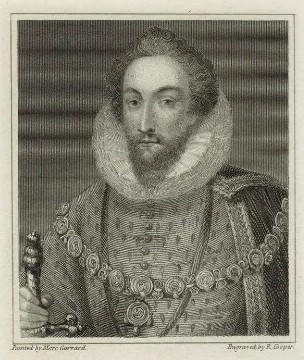
On this, Henry’s 500th birthday, we celebrate the life of a man who was most likely a Tudor prince. Henry Carey, Lord Hunsdon, very likely spent his life as an unacknowledged son of King Henry VIII, and the way his wardship was handled is one of the clearest structural clues to that hidden paternity.
Opening: Henry’s Birth and Context
Henry Carey was almost certainly conceived toward the end of his mother, Mary Boleyn’s, affair with Henry VIII in June 1525 and born on 4 March 1526. His legal father was William Carey, but the historical evidence, contemporary rumors, and genetic evidence point toward Henry VIII as his biological father and suggest that Henry Carey’s entire life was quietly shaped around that fact. The management of his wardship after William Carey’s death in June 1528 is especially revealing because it shows the Crown treating him not as an ordinary gentleman’s heir, but as someone whose existence required close, continuous, and unusually high-level supervision.
William Carey’s Death and the Problem of Provision
When William Carey lay dying at Pleshy in June 1528, his decisions were strikingly out of step with normal paternal behavior. Instead of securing the futures of his two young children, Catherine and Henry, by making a Will, his primary focus appears to have been promoting his sister to the abbacy of Wilton. He died intestate: there is no evidence of a Will and the Inquisition Post‑Mortem record indicates that he made none.
On the surface, this shows a remarkable failure to provide for his own minor children that is inexplicable. Yet if William Carey believed that both children were, in reality, the king’s offspring, his apparent neglect becomes easier to understand. In that scenario, the real guarantor of their future would not be their nominal father but Henry VIII himself. Moreover, it is entirely plausible that, during Mary Boleyn’s liaison with the king, an understanding emerged: any children born to Mary would be Careys in law and name, while the king undertook to see them safely and comfortably provided for. Such an arrangement makes much better sense of William Carey’s otherwise puzzling priorities at the end of his life.
What “Normal” Wardship Should Have Looked Like
In Tudor England, the wardship of a minor heir followed well-known patterns. When a father holding land died, leaving a child heir, the guardianship of that child and the profits of the lands (plus the right to arrange the heir’s marriage) normally went:
- First, to close paternal kin, especially a grandfather or uncle.
- Secondly, a powerful political ally of the Crown.
- Failing those, to someone who purchased the wardship as an investment and a source of income.
Henry Carey was two years old when his legal father died. Under ordinary practice, his wardship would have fallen to a paternal relative: most obviously, his grandfather Thomas Cary (d. c. 1536) or his uncle John Cary (d. 1552). Both were passed over. Given that the Boleyns were rising fast at court, the king might next have granted the wardship to Henry’s maternal grandfather, Sir Thomas Boleyn, or his uncle George Boleyn. They, too, were overlooked.
That sequence of omissions is very highly unusual. Under normal circumstances, the Cary’s would have fought for the wardship of the family heir to keep his lands and income within the Carey line. Their total silence and the lack of protest when Anne stepped in suggest they knew—or were told—that this child was “Crown business.”
A well-connected, well-born child with land and prospects did not drift past every obvious male kinsman on both sides of the family without a strong reason.
The First Anomaly: Granting Wardship to Anne Boleyn
Instead, Henry VIII granted the boy’s wardship to Anne Boleyn, his maternal aunt and the king’s intended future wife. She was:
- A woman, not a paternal male relative,
- Lacking experience with children,
- Already under intense pressure as the king’s probable future queen and hoped‑for mother of legitimate heirs.
Assuming the financial and legal oversight of a small boy was, for Anne Boleyn, a profound inconvenience. In 1528, she was already navigating the King’s Great Matter, battling for her status at court, and calculating the future of her own dynasty. If Henry Carey were merely the undistinguished son of a minor Cary second son, there is no logical reason for Anne to have accepted such a burden. Had she wished to support her kin, she could have simply asked the King to grant the wardship to her father or brother—a request Henry VIII would have surely granted.
Furthermore, the theory that Anne acted out of “sisterly kindness” to relieve Mary Boleyn’s poverty does not hold up under scrutiny. Their relationship was fraught and rarely characterized by self-sacrifice. More importantly, the King had already secured Mary’s personal finances; he interceded directly with Thomas Boleyn on her behalf and granted her an annuity of £100 from the Earl of Derby’s lands. She also received 100 marks from the Priory of Tynemouth—a favor from a Prior some historians believe was a cousin to the King. If the King was already using covert family channels to fund his illegitimate offspring, Anne’s intervention was not about money—it was about control.
If Henry was “just a Carey,” he represented no value to Anne. However, as a potential royal bastard, he was a distinct dynastic threat. By taking the wardship, Anne ensured Henry was raised under her roof, educated by her hand-picked tutors, and conditioned to owe his entire career to her. She effectively “domesticated” a rival to her future children’s throne. One does not leave a royal bastard to be raised by the Cary family, where he might become a figurehead for a rival faction. Instead, Anne used her position to instill in him a lifelong duty to her own lineage, a strategic policy the king himself copied when the boy’s wardship reverted to the Crown at Anne’s death in 1536.
This arrangement becomes coherent only if Henry Carey’s importance far exceeded his official parentage. If Anne understood he was the King’s child, and she would have been privy to that truth, his welfare became a matter of urgent dynastic concern rather than optional kindness. Placing Henry with Anne allowed the couple to maintain a tightly controlled environment: he was kept near the center of power and positioned so that his future marriage could be managed to avoid threatening the succession. In this light, the wardship looks less like a favor to a sister and more like a calculated, discreet solution to a royal problem.
The Second Anomaly: After Anne’s Fall
The second, and perhaps even more telling, phase of the story begins with Anne Boleyn’s downfall. In 1536, the Boleyn family fell abruptly from power into disgrace. One would expect the wardship of a Boleyn‑connected boy to be promptly reallocated. In ordinary circumstances, Henry Carey’s wardship and marriage rights would:
- Revert to the Crown, and
- Be sold for ready cash or granted to someone else—very likely his uncle Sir John Cary—bringing both money and patronage benefits.
This was a period when Henry VIII was eager for income, even to the point of dissolving monasteries to raise funds. A valuable wardship like Henry Carey’s was a monetizable asset. Yet the king did not cash it in. He did not sell it to a courtier. He did not hand it over to the Cary family. Instead, the Crown retained control.
Such behaviour is very difficult to explain if Henry Carey was merely a minor courtier’s child, “a nobody son of a minor country gentleman.” In that case, his wardship would have been a tidy financial and political opportunity. The refusal to treat it that way points to a different logic: Henry VIII regarded this young man as someone whose future could not safely be left in other hands.
Wardship as Silent Admission of Paternity
Viewed together, the two main stages of Henry Carey’s wardship form a consistent pattern:
- First, his guardianship bypassed all obvious male relatives and was given to Anne Boleyn, a politically overburdened woman whose real qualification was her intimate connection with the king.
- Later, after Anne’s execution and the Boleyns’ disgrace, the Crown still refused to treat Henry’s wardship as a saleable asset and retained it instead of passing it to his Cary kin or another patron.
These are not random administrative quirks. They make little sense if Henry Carey was an ordinary Carey heir. They make excellent sense if he was, in the eyes of the king and those around him, Henry VIII’s own son—a royal problem to be managed long‑term, rather than a simple piece of property to be exploited for cash.
In that reading, the case of Henry Carey’s wardship is not a footnote but one of the strongest structural arguments that he was an unacknowledged Tudor prince, whose life was quietly arranged to preserve both his comfort and the security of the succession, without ever forcing the king to acknowledge him openly.
Sources:
Primary Sources
• Letters and Papers, Foreign and Domestic, of the Reign of Henry VIII, ed. J. S. Brewer et al.
• Inquisitions Post Mortem, The National Archives (UK)
• Nicholas Sander, De Origine ac Progressu Schismatis Anglicani (1585)
Secondary Sources
• Eric Ives, The Life and Death of Anne Boleyn (2004)
• Alison Weir, The Six Wives of Henry VIII (1991)
• Elizabeth Norton, The Boleyn Women (2013)
• David Loades, Henry VIII: Court, Church and Conflict (2007)
• J. H. Baker, An Introduction to English Legal History (2002)
• John Burke, A Genealogical and Heraldic History of the Extinct and Dormant Peerages of the British Empire (1831)
 The Obsessed Tudor
Leave a comment