15 January 2026
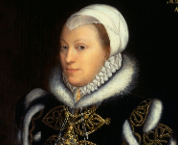
Four hundred and fifty-seven years ago, on 15 January 1569, at Hampton Court Palace, Lady Catherine Knollys died after a year marked by recurring bouts of illness and fever. Although she had been unwell during the previous summer, she eventually rallied sufficiently to attend Queen Elizabeth I’s Christmas celebrations, as was expected of her role as Chief Lady of the Bedchamber. Her health, however, soon deteriorated once more, and this time she did not recover. As the first cousin to Elizabeth I, and publicly unacknowledged half-sister, Catherine was the queen’s closest kin, and beloved by her. Elizabeth ordered that Catherine be nursed in a chamber adjoining her own and visited her frequently during her final days.¹ Although Catherine had long been separated from her husband, Sir Francis Knollys—who at this time was serving as guardian to Mary, Queen of Scots—it is likely that her nineteen-year-old daughter Elizabeth Knollys was present and provided comfort to her mother.² Catherine was forty-five years old at her death, only a few years older than her mother, Mary Boleyn, had been when she died in 1543.³
Catherine Carey was born in 1524, during the height of her mother’s affair with King Henry VIII.⁴ The consensus of most reputable Tudor historians today is that Catherine was the King’s unacknowledged daughter. Her legal father, William Carey, Mary Boleyn’s first husband, acknowledged her as his daughter; however, contemporary rumor, circumstantial historical evidence, and my recent genetic research overwhelmingly indicate that Henry VIII was her (and her brother Henry’s) biological father.⁵ Some historians have argued that because the King never publicly acknowledged Catherine, or her brother for that matter, she cannot have been his child. Yet the absence of public acknowledgment does not equate to the absence of paternity.
The case of Henry FitzRoy illustrates this point clearly. Born in 1519 to the King’s mistress, Bessie Blount, FitzRoy was not publicly acknowledged until he was six years old—and only when such recognition served Henry VIII’s political interests. This precedent demonstrates that the King was entirely capable of concealing the existence of an illegitimate child unless and until acknowledgment proved advantageous. Had Katherine of Aragon produced a surviving male heir, it is likely that FitzRoy, like the Carey children, would have remained unacknowledged by the King. This pattern reveals that Henry VIII had compelling political, dynastic, and personal reasons for withholding recognition of illegitimate children—considerations that will be examined in greater detail in a future blog. ⁶
During Mary’s affair with the King, William Carey received many royal favors, most notably between 1522 and 1526.⁷ Carey had served at court since 1519, yet significant royal grants only began once Mary’s relationship with the King was underway. These included wardships, keeperships, stewardships, lands, and manors, culminating in the grant of the royal Borough of Buckingham shortly before the birth of Mary’s son Henry. ⁸ Carey undertook no exceptional diplomatic or military service during this period to warrant such largesse independently. Notably, after the affair ended, Carey received no further royal favors during the final two years of his life, despite the Boleyn family’s rising influence through Anne Boleyn. ⁹
Most likely, Catherine spent her first four years of life with her mother and William Carey, likely residing at royal residences, such as Pleshy, which William held the keeperships.¹⁰ Tragically, at only four years old, Catherine lost her legal father—the first of several events that would profoundly shape the course of her life. Carey’s behavior immediately prior to his death is striking: rather than securing provision for his children, he devoted his final efforts to petitioning Cardinal Wolsey for his sister’s appointment as Abbess of Wilton.¹¹ Such behavior appears, at first glance, either remarkably callous or profoundly indifferent. A more plausible interpretation is that William did not believe it necessary to make provision for Catherine and Henry because he was confident that the King would assume responsibility for the welfare of his biological children.
Following William Carey’s death, the wardship of his infant son Henry was granted freely to Anne Boleyn, by then the King’s intended wife.¹² This was an extraordinary and highly irregular decision. Wardships were a lucrative royal prerogative, typically granted to close paternal relatives or sold to powerful magnates. In Henry Carey’s case, his paternal uncles, John and Edward Cary, were the obvious and customary candidates, yet both were passed over. His maternal grandfather, Thomas Boleyn, was also disregarded. Instead, control of Henry’s estates, income, education, and future marriage was given to his maternal aunt. If the two-year-old Henry Carey were merely the son of a minor country gentleman with no title, great wealth, or royal significance, such a decision is very difficult to explain, and it is peculiar why Anne would willingly take on her nephew’s wardship at such a stressful time. Such a decision on the King’s part strongly suggests royal interest extending beyond conventional familial duty and will be discussed in more detail in a future blog.¹³
We know from a letter written by Henry VIII to Anne Boleyn in late 1528 that the King exerted pressure on Catherine’s maternal grandfather, Thomas Boleyn, to take Mary and her children into his household once Anne received Henry’s wardship.¹⁴ Contrary to later historians’ claims that Anne’s intervention benefited Mary, the removal of Henry’s wardship from his mother almost certainly worsened Mary’s financial position and limited her ability to care independently for her children. By December 1528, the King had re-granted Mary Boleyn a £100 annuity from the lands of the Earl of Derby, perhaps at Anne’s urging, but more plausibly as a means of supporting Catherine and Henry.¹⁵
Between 1528 and early 1534, Catherine likely spent most of her childhood in the country, either at Hever Castle or another Boleyn residence, under the supervision of a nurse or governess. During this period, Mary Boleyn appears to have divided her time between her children and service in her sister’s household at court, although her son was by then a ward of his aunt. This fragile stability ended abruptly in September 1534, when Mary was banished from court by both King and Queen, supported by the wider Boleyn family.¹⁶ Mary had secretly married William Stafford, a second son, soldier, and man of no wealth or position. A man socially and financially inferior to the sister of a reigning queen. For Catherine, now about ten years old, this marked the second tragic rupture in her family life.
After Mary’s disgrace, Queen Anne likely assumed responsibility for Catherine’s upbringing, declaring Mary unfit to raise her daughter, placing her in the household of her own daughter, Princess Elizabeth.¹⁷ This arrangement appears to mark the beginning of the extraordinarily close relationship between Catherine and Elizabeth, which endured until Catherine’s death. From 1534 to 1539, Catherine most likely served in Elizabeth’s household at Hunsdon, Hatfield, and other residences of the royal children.¹⁸ Catherine would likely have been present during the traumatic events surrounding Anne Boleyn’s execution in May 1536, and it is reasonable to suppose that her companionship and care helped to sustain the young Elizabeth during that period. The unbreakable bond forged in their shared childhood adversity would later mature into one of the most enduring and intimate relationships of Elizabeth’s life and is demonstrated in the famous Cor Rotto letter.¹⁹
One of the most compelling pieces of historical evidence supporting the royal paternity of the Carey children is a documented incident that occurred less than a year after the executions of Anne and George Boleyn. In Letters and Papers, Foreign and Domestic, Henry VIII, dated 3 April 1537, Robert Blakeney, the newly appointed prior of Tynemouth Priory, wrote to Thomas Cromwell concerning an annuity previously assigned by his predecessor, Thomas Gardiner, to Mary Carey, now Mary Stafford.²⁰ In his letter, Blakeney explained that, following the recent collapse of the Boleyn family, Mary was in no position to offer patronage or assistance to the priory and therefore requested permission to terminate the annuity. Crucially, Blakeney admitted that he had already ceased payment, only to be ordered by the Lord Chancellor Sir Thomas Audley to resume it. Seeking relief from this command, Blakeney appealed directly to Cromwell, hoping he would authorize the annuity’s cancellation. Instead, Cromwell likewise instructed that the payments continue.
This episode is striking, and I believe one of the greatest pieces of historical evidence in support of the Carey children’s Tudor paternity. Here were two of the most powerful men in England, second only to the King himself, independently insisting on the continuation of an annuity to a woman who had been the King’s mistress more than a decade earlier and who now possessed no title, no wealth, and whose family connections were toxic.²¹ Such intervention cannot be explained by sentiment or by political necessity. Cromwell was the chief architect of Anne Boleyn’s downfall and had no incentive to protect or assist a Boleyn relative. His actions in this matter run directly counter to his established hostility toward the family.
The only plausible explanation is that the annuity was maintained at the King’s personal command. Henry VIII was not a man given to nostalgic generosity, particularly toward discarded mistresses or members of a disgraced family he openly repudiated. That he nonetheless ensured Mary Stafford’s continued financial support strongly suggests that the annuity functioned as a discreet mechanism for the upkeep of her children. In this context, the payments appear less an act of charity than a deliberate, covert provision—one consistent with a king unwilling to acknowledge his offspring publicly, yet equally unwilling to abandon them entirely.
Two years later in 1539, the King appointed Catherine to serve his new queen, Anne of Cleves, as a maid of honor. Incredibly and simultaneously, Henry VIII also appointed her stepfather, William Stafford, to the King’s company of Gentleman Pensioners —an elite corps of royal bodyguards who attended the king in both ceremonial and protective roles.²² Catherine was only fifteen, the niece of an executed queen, who possessed no title, no independent wealth, and belonged to the Boleyn family, whose catastrophic fall from royal favor had occurred scarcely three years earlier.²³ Such an appointment defies conventional explanation unless it is understood as an expression of the King’s quiet paternal concern and a deliberate act of royal protection.²⁴ This appointment marks the beginning of the royal favors the King bestowed on Catherine from 1539 until his death in January 1547.
On 26 April 1540, Catherine married Francis Knollys, a rising courtier and member of the King’s bodyguard.²⁵ It is unknown whether the King attended the ceremony or whether Catherine’s mother, Mary Stafford, was present. However, given William Stafford’s service in the King’s household by this period, it is plausible that Mary attended the wedding. With both Stafford and Catherine serving at court, and with Mary absent from surviving court records, I believe she chose to reside nearby in order to remain close to her family. Knollys himself was a member of the King’s bodyguard and had already sat in Parliament several times, marking him as a man firmly embedded within the Tudor political and courtly elite.
Shortly after their marriage, Henry VIII secured the Knollys family’s traditional seat, Rotherfield Greys in Oxfordshire, for Francis and Catherine. The King had already demonstrated his favor toward Francis in 1538 by granting him the estate in fee simple. In Tudor England, however, land tenure remained precarious: royal grants could be revoked by subsequent monarchs or challenged by rival claimants. Anticipating these risks, Henry VIII went further by having the grant confirmed by an Act of Parliament²⁶ soon after the Knollys’ marriage. By converting a personal royal gift into statutory law, the King rendered the estate exceptionally secure and immune from legal seizure.
Even more striking was the King’s decision to make Catherine a joint tenant in the estate. Under the doctrine of coverture, a married woman’s legal identity and property rights were ordinarily subsumed into those of her husband, and substantial landed property was almost always held and controlled in the husband’s name. Henry VIII’s intervention, therefore, elevated Catherine far beyond the normal legal and economic status of a Tudor wife, ensuring that she could neither be easily disinherited nor set aside, an extraordinary departure from normal coverture practice.²⁷
Of additional interest is the naming of Catherine and Francis Knollys’ first two children, which may reflect an acknowledgment—subtle but meaningful—of Catherine’s biological parentage. Her first two children were named Mary (1541) and Henry (1542), possibly reflecting acknowledgment of her parentage.²⁸ In total, the couple had fourteen children, many of whom would go on to become prominent courtiers and political figures during the reign of Elizabeth I.²⁹
By the late 1530s and into the final decade of his reign, Henry VIII’s temperament had altered markedly. Increasingly suspicious and distrustful, the King became intensely selective about those he allowed into his immediate circle, appointing only men he believed he could trust implicitly. Against this backdrop, it is notable that Catherine’s stepfather, William Stafford, was elevated to the intimate position of Esquire of the Body in 1541, which represents a remarkable rehabilitation.³⁰ This advancement is striking, given that only seven years earlier Stafford had been deemed socially unsuitable to marry Mary Boleyn, a union that resulted in their banishment from court. The King’s decision to restore and promote Stafford, his one-time brother-in-law, may reflect a deliberate effort to stabilize Mary and her household at a time when Henry Carey was still a minor. Such patronage is consistent with the King’s pattern of covert and discreet provision—support offered without public acknowledgment, yet clearly sustained by royal authority.
Around 1545, the King appointed Catherine’s husband, Francis Knollys, as Master of the Horse to Prince Edward. This was an exceptionally prestigious appointment, placing Francis in daily and intimate contact with the heir to the throne.³¹ As the prince’s senior court officer responsible for all matters relating to the horses, stables, and mounted transport of the household, the Master of the Horse ranked in household precedence below only the Lord Steward and Lord Chamberlain. The office combined practical authority over a large operational department with considerable ceremonial honor and visibility, particularly during public processions when the officer rode in very close proximity to the prince.
It must be remembered that Prince Edward was the most important person in Henry VIII’s life: the long-awaited male heir for whom the King had broken with the Catholic Church, divorced his first wife, founded the Church of England, and married—and executed—his second wife. To entrust Francis Knollys with such a role, therefore, reflects an extraordinary degree of confidence and trust in him. I would argue that Henry appointed Francis not merely because of his competence, but because he regarded the Knollys as family and wished to ensure that his son was surrounded by loyal and trusted kin, even kin who were unacknowledged. Moreover, I believe this was a strategic appointment, and may be understood as another means by which the King discreetly provided for Catherine, ensuring that her household would remain close to the center of power when Edward eventually ascended the throne.
King Henry VIII died on 28 January 1547 at the Palace of Whitehall. By that time, he had deliberately positioned the Knollys family close to the young prince so that, when the reign of Edward VI commenced, they would not be forgotten. Henry VIII’s sustained actions toward the Carey children—Catherine in particular—reveal a consistent, if carefully managed, discreet paternal interest. In the decades that followed, the Knollys family would become one of the most powerful families in Elizabethan England, a rise made possible by their close kinship with the Queen. Catherine served her cousin—and half-sister—honorably, loyally, and with unwavering dedication until her death.
I do believe Elizabeth knew the Careys were not only her first cousins but her half-siblings, and I do believe she privately acknowledged them as such. But Elizabeth was pragmatic enough to know that publicly acknowledging them would put her own throne in jeopardy as it would have threatened the validity of her own parents’ marriage and, therefore, her own legitimacy to reign. But when Catherine passed away, Elizabeth ensured she took her rightful place amongst her true ancestors, providing her with a full heraldic state funeral attended by the most important men of the time, and laid her to rest in St. Edmund’s Chapel, close to the Lady’s Chapel where other Tudors were laid to rest in Westminster Abbey.³²
It is reasonable to conclude that Henry VIII had the foresight to strategically place the Carey children during their childhood in positions that impressed upon them a lifelong duty to the Tudor dynasty, to their family. Henry VIII would never have publicly acknowledged the Carey children for several compelling reasons, chief among them the catastrophic damage such acknowledgment would have inflicted on his reputation as a moral and religious authority, particularly given that the children were born to a married mistress. There was nothing to be gained—and everything to lose—by publicly acknowledging the Carey children. Non-acknowledgment is therefore expected behavior, not contrary evidence. Yet when this documentary evidence is considered alongside persistent contemporary rumor, now further reinforced by genetic data, the cumulative weight of the evidence points decisively toward Henry VIII’s paternity of not only Catherine but her brother Henry too. A question that has lingered for nearly five centuries can now be answered with far greater confidence, and Catherine and her brother may at last be understood within the context of their rightful place among their Tudor family. Considering the Careys’ unwavering loyalty, service, and duty to Elizabeth and the Tudor dynasty, they deserve that recognition.
Footnotes
- John Nichols, The Progresses and Public Processions of Queen Elizabeth
- George Carey, Memoirs of the Carey Family
- Eric Ives, The Life and Death of Anne Boleyn
- Antonia Fraser, The Six Wives of Henry VIII
- Author’s genetic study (unpublished; triangulated autosomal analysis)
- David Starkey, Six Wives: The Queens of Henry VIII
- Letters and Papers, Foreign and Domestic, Henry VIII, vols. III–IV
- Ibid.
- Retha Warnicke, The Rise and Fall of Anne Boleyn
- Calendar of Patent Rolls, Henry VIII
- Letters and Papers, vol. IV
- Ibid.
- G.W. Bernard, Anne Boleyn: Fatal Attractions
- Letters and Papers, vol. IV
- Ibid.
- Antonia Fraser, Mary Boleyn
- Eric Ives
- Calendar of State Papers
- Elizabeth I, Cor Rotto letter
- Letters and Papers, vol. XII
- Diarmaid MacCulloch, Thomas Cromwell
- Calendar of State Papers
- Ives
- Bernard
- Calendar of Patent Rolls
- Statutes of the Realm
- Susan Doran, Women and Politics in Tudor England
- Knollys family papers
- Wallace MacCaffrey, Elizabeth I
- Letters and Papers, vol. XVI
- Calendar of State Papers
- Westminster Abbey burial records
Selected Sources
- Bernard, G. W. Anne Boleyn: Fatal Attractions
- Fraser, Antonia. The Six Wives of Henry VIII; Mary Boleyn
- Ives, Eric. The Life and Death of Anne Boleyn
- MacCaffrey, Wallace. Elizabeth I
- MacCulloch, Diarmaid. Thomas Cromwell
- Starkey, David. Six Wives
- Letters and Papers, Foreign and Domestic, Henry VIII
- Calendar of State Papers
- Calendar of Patent Rolls
- Statutes of the Realm
- Nichols, John. Progresses of Queen Elizabeth
 The Obsessed Tudor
Leave a comment