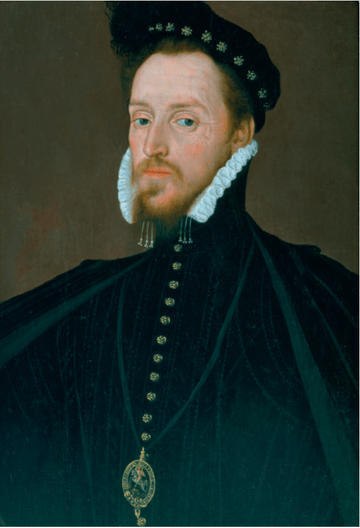
The question of Henry Carey’s paternity has long been approached through the narrow lens of public acknowledgment. Because King Henry VIII never formally recognized Henry Carey as his son, many historians have assumed that Carey must therefore have been the legitimate child of Mary Boleyn’s husband, William Carey. Yet this conclusion rests on a modern misunderstanding of Tudor political practice. In the sixteenth century, silence could be as deliberate as proclamation, and lack of public acknowledgment does not equate to lack of paternity. When Henry Carey’s conception, treatment, naming, wardship, education, and lifelong royal favor are examined collectively, a compelling case emerges that he was an unacknowledged son of Henry VIII.
Henry Carey was conceived during the suspected period when Mary Boleyn was known to be the King’s mistress. No contemporary source explicitly states that the affair ended before Carey’s conception, and in fact, many credible Tudor historians today believe the affair continued into at least the summer of 1525, which fits the conception date of June 1525. Attempts to force such a termination rely on speculative chronology rather than documentary evidence. Given the overlap between the affair and Mary’s pregnancy, the possibility of royal paternity cannot be dismissed and, indeed, fits comfortably within the known timeline of events.
Crucially, the absence of public acknowledgment does not preclude Tudor paternity. Henry VIII openly acknowledged Henry FitzRoy (aged 6) only because it suited his dynastic needs at that particular moment. In other cases, especially when acknowledgment might complicate succession, marriage negotiations, or factional politics, silence was a safer strategy. By the late-1520s, Henry’s pursuit of Anne Boleyn and his desire for a legitimate heir made the public recognition of Anne’s nephew Henry Carey politically hazardous. Concealment, not acknowledgment, best served his interests.
Henry Carey’s very name provides an early and telling clue. Naming conventions in Tudor England were conservative and highly symbolic. As William Carey’s only son and heir, born six years into the marriage, the child would ordinarily have been named William after his father or, at the very least, Thomas after either grandfather. Instead, he was named Henry. It strains credulity to believe that William Carey—cuckolded by the King and likely already raising one royal child in Catherine Carey—would willingly name his heir after the man who had humiliated him. Equally implausible is the notion that Mary Boleyn, discarded by the King in favor of her own sister, would choose to voluntarily honor the King by naming her son after him. The most logical explanation is that Mary named her son after his true father, fully aware that public acknowledgment would never come from the King. Naming the child Henry may have been the only act of recognition her son would get, and which was still within her control.
Henry Carey’s treatment following William Carey’s death further undermines the orthodox narrative. William died of the sweating sickness on 22 June 1528, a disease that often killed within hours. Remarkably, he left no will providing for his wife or children. Instead, his only recorded concern was securing his sister’s advancement as Abbess of Wilton. Such negligence is difficult to explain unless William believed that the King himself would assume responsibility for the children—an expectation consistent with royal paternity.
The wardship of Henry Carey is of great significance due to its uniqueness. The King took the highly unusual step of granting Henry’s wardship to his maternal aunt, Anne Boleyn, by then the King’s intended wife. It was very rare for a woman to be given or granted a wardship during this time period. In Tudor tradition, wardships were usually granted or sold to the paternal relatives, such as a grandfather or uncle, or a powerful magnate. In the case of Henry Carey, these paternal relatives would have been his (legal) grandfather Thomas Cary (d. c. 1536) or his uncle Sir John Cary (d. 1552), both of whom were passed over. This is very unusual; however, alternatively, we do not know if Thomas of John Cary petitioned for Henry’s wardship.
Knowing Anne Boleyn’s character, intense ambition, and acute political sensitivity—particularly during a period when her position at court was precarious and her personal life consumed by the King’s marital crisis—it is difficult to imagine why she would voluntarily assume the financial burden, legal responsibility, and personal inconvenience of overseeing her nephew’s upbringing if he were merely the unremarkable son of William Carey. The argument that Anne took the wardship out of the goodness of her heart for Mary’s sake also does not ring true, given what we know of the sisters’ relationship. Ultimately, these actions do not align with Anne’s documented priorities or behavior. It becomes comprehensible only if Anne knew that Henry Carey was the King’s son and that his welfare was therefore of dynastic importance to her own future children.
Even more revealing is the King’s conduct after Anne Boleyn’s execution. When Henry Carey’s wardship reverted to the Crown, Henry VIII neither sold it nor granted it to the boy’s uncle, Sir John Cary. Again, if Henry Carey were merely the son of a minor courtier with no title or political weight, there would have been no reason for the Crown to retain the wardship. Yet Henry VIII did so, suggesting a personal interest inconsistent with the child’s supposed insignificance.
As Henry Carey grew older, the pattern of royal favor continued. As a teenager, he was appointed to a position within the King’s Household—an opportunity rarely extended without powerful patronage. Such early and direct access to the royal household is more easily explained if Carey was viewed, privately if not publicly, as the King’s own son.
Contemporary rumor reinforces this conclusion. Around 1532, foreign ambassadors referred obliquely to an unacknowledged youth of great promise who was said to belong to the King. This cannot refer to Henry FitzRoy, who was well known and openly acknowledged by that date. Henry Carey, then a young child, fits the profile far better and had been rumored to be the King’s son. Given the extreme sensitivity of the period—when Henry VIII was maneuvering to marry Anne Boleyn—it is unsurprising that the boy was not named explicitly.
More explicit testimony appears in 1535, when John Hale, vicar of Isleworth, recorded that monks at Syon Abbey identified Henry Carey to him as the King’s son by the “Queen’s sister,” whom the Queen would not permit at court. This account is striking not only for its clarity but for its accuracy: Mary Boleyn had indeed been cast out from court by Anne Boleyn. The fact that such knowledge circulated beyond court circles suggests that rumors of Carey’s royal paternity were widespread. The monks of Syon, who interacted with Henry Carey daily during his tenure at the Abbey, were particularly well placed to know the truth of his parentage.
Physical resemblance and character traits further strengthen the case. Numerous observers later noted Henry Carey’s resemblance to Henry VIII and the broader Tudor family, as well as shared personality traits—confidence, bluntness, and interest in the arts. While such evidence is circumstantial, it is far from irrelevant when considered alongside the documentary and behavioral record.
Finally, the language of contemporaries hints at an unspoken truth. Robert Dudley’s later reference to the Careys as “Noli tangere” and of the “Tribe of Dan” strongly suggests a recognized but unstated royal connection. Such coded language was common in Tudor political culture, where discretion often mattered more than explicit acknowledgment.
Taken individually, any one of these points might be dismissed as coincidence or rumor. Taken together, they form a coherent and persuasive pattern. Henry Carey was conceived during the King’s affair with Mary Boleyn (as most historians agree was between 1522-1525), named in a manner inconsistent with his supposed paternity, protected by the King at every critical juncture of his life, and widely believed by contemporaries to be of royal blood. The most logical explanation—one that best fits the evidence and the political realities of Henry VIII’s reign—is that Henry Carey was indeed a Tudor son, quietly acknowledged in practice even if never proclaimed in society and law.
Sources
Letters and Papers, Foreign and Domestic, Henry VIII (LP).
- Vols. II–IV (Mary Boleyn’s affair; William Carey’s career; ennoblement of Thomas Boleyn)
- Vol. IV (1525–1528): William Carey’s death; wardship arrangements
- Vols. V–VIII (Anne Boleyn period; Hale testimony; ambassadorial rumors)
Calendar of Patent Rolls (CPR), Henry VIII.
- Vol. III (1516–1523): Early grants to William Carey
- Vol. IV (1525–1528):
- Grant to William Carey (20 Feb 1526, in tail male)
- Grant of Henry Carey’s wardship to Mary Boleyn (23 June 1528)
- Subsequent wardship arrangements involving Anne Boleyn
- Vols. V–VI: Retention of Henry Carey’s wardship by the Crown after 1536
 The Obsessed Tudor
Leave a comment